

Chapter 4: Uninsured Motorist
Chapter 4
Uninsured Motorist
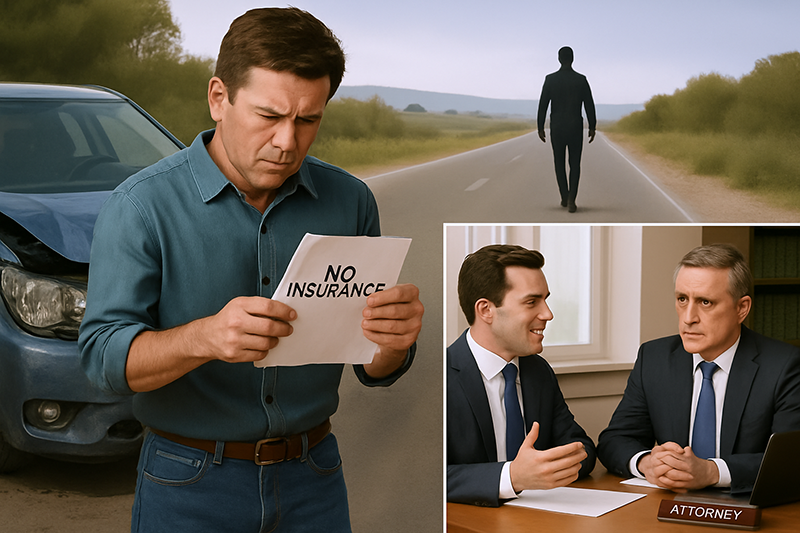
What do I do if I am injured and the other guy doesn’t have insurance?
That can be a pretty easy question or a pretty difficult question depending upon how good your insurance agent is. If your insurance agent has allowed you to buy a policy that does not have uninsured motorist coverage, then you have a claim for damages against the individual who caused the accident. There is likely no insurance coverage (although you should
definitely talk to an attorney to determine whether there is any other avenue for recovery). You are likely stuck with an individual (whom you already know does not exercise the financial responsibility to pay their insurance bills) as your sole source of recovery. Not a very good situation to be in.
If, however, your insurance company and your insurance adjuster convinced you to purchase uninsured/underinsured coverage on your automobile policy, you may have a relatively bright outlook for your claim.
Uninsured motorist coverage is exactly what it sounds like, coverage when there is no coverage for the other driver. When
the other driver is uninsured, your insurance company has promised to essentially extend coverage to him. Now, they do not have contractual privity with the other driver and, therefore, do not owe him any obligations or duties. He is on his own. In fact, if you do recover through your own uninsured motorist policy, your uninsured carrier will likely go after the uninsured driver for subrogation. In other words, they will try to get back the money that they pay you from the uninsured driver directly. That doesn’t really concern you, but it is of interest to some claimants who are upset that people are driving around without insurance and causing accidents. For those people, I can assure you that the
person who caused the accident and who was uninsured has not walked away scot-free. There are criminal and civil and drivers’ license repercussions that will follow them as a result of this accident.
For your part, though, you have no worry about pursuing that person and making him/her pay for his/her actions. Your uninsured motorist coverage will, for all intents and purposes, function as liability insurance for the other party.
One thing that is often surprising to injured claimants is that their insurance company will still defend their personal injury claim just as aggressively as a liability insurance company. In other words, they will often defend the actions
of the uninsured driver. They will also call into question whether your injuries were caused in the accident. They will also call into the question the severity of your injuries and the propriety of awarding you any amount for pain and suffering.
As a practical matter for the claimant, there is no difference between fighting a claim against a liability insurance company representing a negligent driver than there is bringing an action against your own insurance company when the negligent driver did not have insurance. This is difficult for people to accept. Oftentimes people have a romanticized idea about their relationship with their insurance company. Those romantic stories typically end when there is an
uninsured claim. If you are convinced that your insurance company will treat you fairly because you have been a customer for 16 years, you need to take a step back and think again. Insurance companies are not evil or mean- but neither are they benevolent, nice, or loyal.
Insurance companies are multinational, multibillion-dollar corporations that exist to make money. There is nothing wrong with that- as long as you understand that every claim and every interaction with an insurance company is a business matter. They do not have it in for you. They do not hate you. They do not like you and they do not–believe it or not–value your business (at least not the adjuster who is working your claim; now your
commission-based agent is a different story).
Insurance companies make money by charging premiums and lose money by paying claims. They love to do the first and absolutely abhor doing the second. If you have an injury claim with your own insurance company, you should do what your insurance company does: treat it as a business interaction. Talk with attorneys. Find out your rights and the insurance company’s obligations to you. Arm yourself with information and pursue your claim like a businessperson.
Finally, it’s important to understand that your uninsured motorist carrier, like a liability carrier, has a limit that they will
pay on each claim. You can look at your declarations page or ask your agent to tell you what that limit of payment is. Your insurance company will not pay more than the amount of insurance that you purchased. Next we will look at the other part of underinsured/uninsured motorist coverage.
Underinsured Motorist Coverage
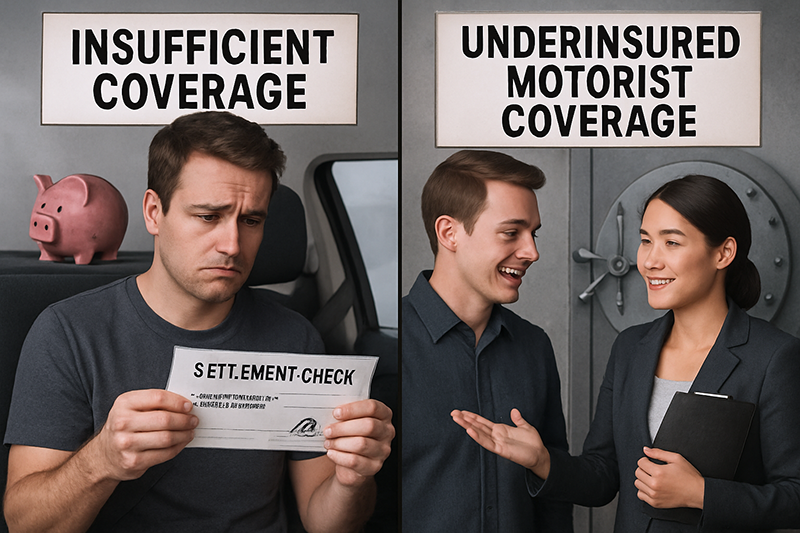
What can I do if there is not enough coverage under the at-fault driver’s liability policy?
Underinsured motorist coverage is just what it sounds like, too. If the careless motorist that injures you does not carry enough insurance to compensate you for your loss, including pain and suffering
damages, then you can look to your own policy and its underinsured motorist provisions. In other words, because the person who hit did not have enough insurance (was underinsured) you can file a claim with your own policy. It is important to understand that you must first establish that the liability carrier for the other party has inadequate limits. If you do not get an offer and settle with the liability carrier first, your own underinsured motorist carrier will not talk with you about your claim.
Special care must be taken to contact your underinsured motorist carrier before settling with the liability carrier. If this part of your claim is not handled properly, you may lose any right to
recover under your underinsured motorist policy. This is because the underinsured motorist policy states that you must give your underinsured motorist carrier notice of the fact that you are going to settle with the liability carrier. You must also give them an opportunity to advance that money and preserve their subrogation rights against the liability carrier and the at-fault driver. Most times the underinsured motorist carrier will not choose to preserve their claim against the individual and will allow you to settle with the liability carrier. However, if you do not get written consent from your underinsured motorist carrier before settling with the liability carrier, then you have violated the terms
of your policy and you have no underinsured motorist claim.
The best course of action when dealing with insurance companies is to allow a professional to deal with the insurance companies. That way you can be certain that the claim against your underinsured motorist carrier survives the settlement with the liability carrier.
As a side note here, it is vitally important that you make certain that your insurance agent sells you uninsured/underinsured motorist coverage. By some estimates there are as many as 15% of the drivers out there that do not have valid insurance. Therefore, if you don’t carry uninsured/underinsured motorist
coverage and are in an accident with an uninsured driver, there will be no source of recovery for any of your losses (unless you have medical payments coverage on your automobile).
Even if the person does have insurance, there is a pretty good likelihood that they only carry $50,000 per person in liability insurance coverage. That is the minimum that an individual can carry on their car in Alaska. While that amount is the largest in the country, anybody who has paid medical bills in Alaska knows that one trip to the emergency room, a few diagnostics and an overnight stay in the hospital would easily exhaust $50,000. After that, without underinsured motorist coverage you would be on your own. So
talk with your agent about underinsured motorist and discuss the importance of insuring yourself against financially irresponsible drivers.