

Chapter 2: Property Damage
Chapter 2
Property Damage
The question, “do I have a claim?” begins with the question, “is there a liability case?” As mentioned before, many people don’t know what a liability case is so it may be difficult for people to determine this. Basically a liability case, in the context of an automobile accident, is a
First of all-and with regard to property damage- I should note that the previous chapter, which deals with liability and apportionment of fault, will apply to property damage just as it does to bodily injury claims. In other words, if you are driving an automobile that is damaged because of someone else’s carelessness, you can recover for property damage only to the extent that the other driver was at fault. If the other driver is 90% at fault, you can only recover 90% of your damages from him or her.
What is property damage?
As its name implies, property damage is recovery from a careless driver and his insurance company for damage to your
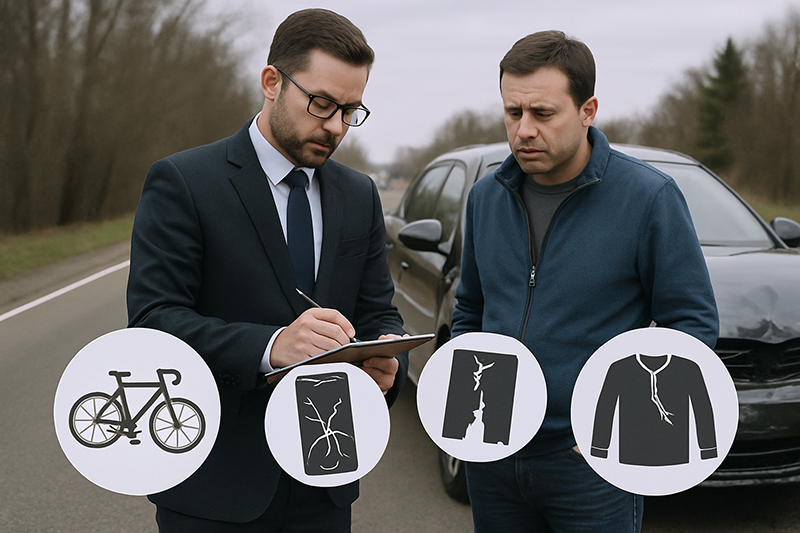
own personal property. Everyone knows that your car is your personal property and should be covered under property damage liability. Some people do not know that other personal property is also covered: Bicycles, telephones, clothes that are cut off during emergency medical treatment, etc … All of those items are covered under property damage and you should be able to submit a claim for any of those items as well as your automobile damage. This chapter, however, will discuss property damage only as it relates to automobiles.
Property damage can be handled through either the liability portion of the at-fault driver’s insurance coverage or, if you have it, through the collision portion of
your own policy. We’ll discuss each of those in turn. First of all, property damage under the liability policy of the other driver’s insurance can be handled separately from your bodily injury. Most legal claims that you may have against other people have to be brought at the same time. In other words, if you sue someone over damages that you suffered because of unfair and deceptive trade practice, you also have to, at that time, bring an action against them for other transgressions such as intentional infliction of emotional distress, breach of contract, or breach of some statutory dutyat the same time you bring the other partof the action-otherwiseyou will lose theunclaimed causes of action.
With automobile accidents, it’s different. You’re allowed to bring property damage as a claim against a liability policy and to even settle that claim while still keeping open your claim for bodily injury. The reason for this is obvious: insurance companies should not be able to hold off settling your property damage claim because you are not willing to settle your injury claim. By their very natures, property damage claims are quickly identifiable and bodily injury claims may take months to fully manifest. As a result, the legislatures in every state in the Union allow claimants to settle property damage without settling their bodily injury claim. But the legislatures go even further.
As explained later in this book, insurance companies paying under a liability policy have no obligations to a claimant. The claimant does not have a contract with the liability company and therefore no contractual obligation exists, no duty attaches. However, state legislatures have created obligations and duties by statute for insurance companies. These duties and obligations were enacted in order to compel insurance companies to settle property damage claims quickly and fairly.
Many years ago insurance companies held all the cards when it came to property damage. They could offer lowball offers for thousands of dollars less than the automobile was worth because people
didn’t have enough money lying around to buy a new automobile without settling on their wrecked car; and because people needed cars to get to work and everything else, oftentimes the consumer was forced to settle for less than his car was worth. On many occasions I heard from a claims supervisor, “keep that offer right where it is. They’ll get tired of walking”.Legislatures began to allow insurance claimants to separate their claim and also began to compel insurance companies to conform to certain guidelines when it came to property damage claims, even liability property damage claims. Simply put, an insurance company that does not comply with the statutory requirements for a repair or a total loss settlement will
be in breach of an implied covenant of fair dealing and will be subject to a lawsuit. Insurance companies don’t like lawsuits very much – so by and large you can expect your property damage claim to be handled promptly and pretty fairly. Insurance companies like to take credit for this prompt and fair settlement of property damage claims. They take credit for how quickly and fairly they deal with you on the property damage and then use that as a clear example that you can count on them to work fairly with you on your bodily injury claim. Be wary of these claims and these examples.
The insurance company settles your property damage claim with a proverbial governmental “gun to their head” and
they take credit for what they have to do anyway. At any rate, what’s covered under liability and property damage is that the car must be either repaired or replaced. We will talk about each of those terms, but first let’s talk about how an insurance company determines whether they’re going to repair or replace a vehicle.
The Insurance Company’s Decision to Repair or Replace a Vehicle
The decision about whether an insurance company will replace or repair a vehicle is entirely a financial decision. They do not take into consideration what a nice person you are or how cool your car is or how much you owe on your vehicle.
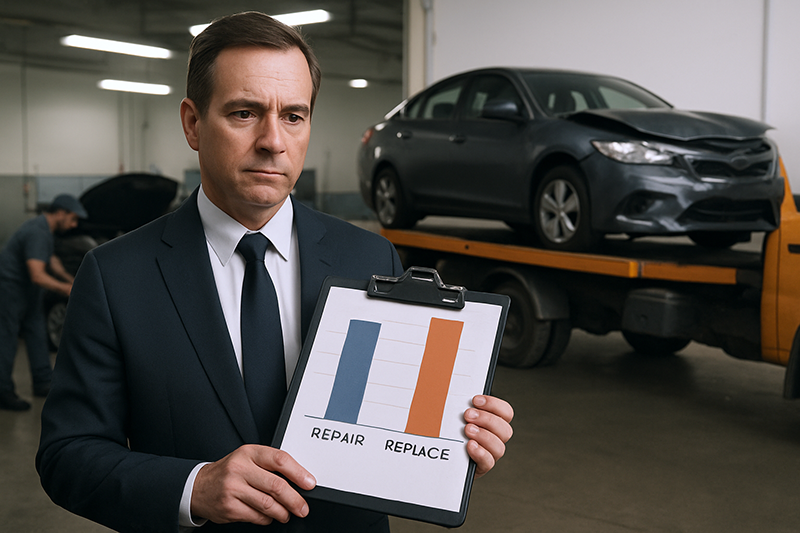
Their decision simply comes down to: will it be cheaper for the insurance company to repair the vehicle or to replace the vehicle? They will get an estimate for there pair of the vehicle from one of their insurance adjusters. That adjuster will argue with the body shop and try to get the vehicle repair cheaper if it all possible. By the way, be wary of the shops that the insurance company sends you to. Consciously or unconsciously those bodyshops are somewhat beholden to the insurance companies that send them business every week. In other words, when there is a discussion regarding what measures should be taken to repair your car correctly, a body shop that gets several wrecks a month from the insurance
company will likely agree with their plan for repair.
Repairs can be completed with LKQ parts (like kind and quality). This is a source of frustration for many people. They want all new parts. Unfortunately, the consumer and the claimant do not have the right to compel the use of new parts. The argument goes: the vehicle was used, so it is proper to use like kind and quality (used) parts to effectuate the repairs. Note: this does not mean that the insurance company can use inferior quality parts or parts that have rusted or deteriorated. However, if you have a pretty common vehicle, you can safely assume that the parts that are being used
to repair your vehicle are being harvested from another wrecked car.
If the insurance company decides that the repairs and the rental, together with any diminution (diminished value) claim, would cost more than it would cost for them to buy the vehicle from you and sell it at salvage, the insurance company will decide to total your car. A car that is declared a total loss is basically the subject of an involuntary sale. You didn’t want to sell your car to the insurance company, but because it makes more sense for them financially, that’s what’s happening. They do not owe you what you think your car is worth. They do not owe you what you owe on your car. They do not owe you what you paid for your
car. They owe you the market value of your vehicle. That is what your vehicle would have sold for on the day the accident occurred in an arms-length transaction with another private citizen. That means private party value.
If you look up the value of your car on Kelly Blue Book or NADA for comparison, you should be certain that you are looking for the private party value. The retail value, the value that the vehicle could sell for if it were on a used car lot, will be too high. The trade-in value will be too low. As discussed earlier, insurance companies often used to play with these numbers. Now the legislature has ended these games. Insurance companies now have to get an independent, government certified
appraiser (all insurance companies in Alaska that I know of use a company called CCC) to give them an honest appraisal of the value of your vehicle. Thereafter they have to make an offer for every dime of that appraisal.
Here’s a story that may give the reader some insight into how insurance companies try to short claimants: Many years ago a large insurance company decided that they would pay all claimants $100 less than the appraisal cost for each total loss. Of course, if you save $100 off of each property damage settlement that your company pays, and you pay tens of thousands of property damage settlements a year, your company will save millions by this slight “adjustment” to the appraisal.
The company was rightfully sued for this practice and disgorged millions of dollars to the people upon whom they had used this practice.
Total loss settlements are typically pretty fair. Many people are surprised at how much they get for their vehicle, particularly older vehicles and older trucks in Alaska. They are often quite happy. Of course, as mentioned above, the insurance companies like to take credit for this very fair evaluation and use that evaluation to convince the claimant that they can count on the insurance company to give them a fair settlement for their bodily injury claim. As mentioned above, those two things have nothing to do with one another.
The insurance company makes the total loss offer under duress and under penalty of pain – and lawsuits. No such governmental pressure exists for a bodily injury claim. Nonetheless, people are usually pretty happy with what they get for their car. The exceptions to that rule, by and large, are people who have either rare collectible cars or cars with a lot of aftermarket ground effects, spoilers or stereo equipment. Oftentimes the appraisers do not consider these things when they are collecting their comparables. In such cases the claimant will have to approach the liability insurance company in the same way that they would approach a potential buyer for their car. They will have to show that
there are new tires, or upgraded wheels, or an upgraded suspension, etc … Whatever the claimant does to show this increased value of their vehicle, they will need to present it in writing and in such away that it is obvious that the insurance company has not considered the full value of the vehicle. This will put the claim back into the “bad faith” territory that scares insurance companies, and they may pay more on such a claim-or they may not. When putting together a claim calling into question the appraisal it is important to note that the insurance companies will typically provide you with the appraisal that they received from CCC at your request. This appraisal will contain a
number of vehicles that are similar to yours that are for sale in the general area (Alaska and the Northwest United States). This report can be a handy tool both for contesting the valuation that the insurance company places on your total loss and for locating other vehicles similar to yours in the event that you want to replace your vehicle with the same make and model.
Should I File Liability or Collision for Property Damage?
We next consider whether one wants to file under liability or under collision coverage for their property damage. Collision is first-party insurance. It is typically required on your car if you have
a bank loan. Collision will pay for the repair or replacement of your vehicle in the event that it is damaged. The difference between collision and the liability coverage described above is that it does not matter who was at fault. Collision will pay whether you caused the accident or whether another person caused the accident. Another difference is there is typically a deductible associated with a collision claim, usually $500 or $1,000. In other words, the insurance company will pay for repair or replacement of your vehicle if it was damaged in a collision after you pay the first $500 or $1,000.

Why would I file a collision claim when there is liability insurance and the other guy was at fault?
Short answer, you probably shouldn’t – but there are times when it comes in handy. First of all, liability carriers under the law can take a reasonable amount of time to conduct a coverage and liability investigation. My experience in the insurance industry was that when a claim came in, the first thing that the adjuster is asked to do is to find a reason that the insurance company does not have to pay. So the adjuster will make certain that the at-fault, insured driver has paid his or her insurance premiums. If not, then there was no coverage on the vehicle at the
even a couple of weeks (as it often does), a claimant may choose to go through his/her own collision insurance.
The advantage with collision is that there is only a coverage investigation. If you’ve paid your insurance bills, your insurer should begin either repairing or preparing to pay the total loss on your vehicle immediately. Of course, they will later go after the liability insurance company for the money they pay under your collision policy in what is called a subrogation claim. If your collision carrier is reimbursed for all of the money paid under your collision claim from the liability carrier, they will also collect your deductible and send that along to you. Of course, if they prevail on the subrogation
claim and get their money back, you will experience no increase in your insurance. So the answer to the question, “why would I ever file under my insurance if the other guy is at fault?” is that your insurance will get started right away. Additionally, if you have a rental rider in your policy, they can put you in a rental car right away- no need to wait for the liability carrier to investigate liability before you have a substitute rental car.
While we’re on the subject of rental cars, please remember that the liability company owes you for a rental car for the time that you do not have use of your own vehicle. Ideally that will start the day that you contact them. In reality, the liability company often takes a few days to
investigate coverage and liability. If that happens, you have a couple of choices. First you could rent another vehicle and later, after the liability insurance has determined coverage and liability, present them with the bill for reimbursement. If you choose to do this, you need to be certain that you rent a comparable vehicle. You can’t total a Tercel and go rent a replacement Escalade and expect the liability insurance company to pay for the rental.
Or, you could choose not to rent a vehicle until there is a determination about liability and coverage. If you choose this option, be certain that you approach the insurance company for the at-fault driver with a claim for lost use once they have
determined that they are liable. Lost use is just what it sounds like. You get an amount of money that’s fairly close to what it would have cost to rent a car for each day that you did not have your vehicle. Many people forget to make this claim, which saves insurance companies millions each year in unclaimed, lost use claims.
That briefly covers damages to your car, but what about damages to you or to your passengers? The next section begins the discussion of your personal injury claims. I should note that this is what we at the Crowson Law Group do. We are glad to help people with their property damage claim, but under no circumstances do we take any portion of the initial property