Chapter 1
Alaska Fault Law
The question, “do I have a claim?” begins with the question, “is there a liability case?” As mentioned before, many people don’t know what a liability case is so it may be difficult for people to determine this. Basically a liability case, in the context of an automobile accident, is a
question of whether the person that hit you was driving negligently. There are, of course, many other sorts of negligence claims, but we are discussing automobile accidents for the purpose of this book.
Did the other driver drive carelessly?
This is not always as cut and dried as it may seem, either. The police report and the investigating officer can indicate that one party is at fault, but that finding is not determinative. At the end of the day, the final determination concerning who is atfault-if there is any dispute-would have to fall to the finder of fact in a trialsetting-what the jury thinks about the driving of both parties. Of course, most cases don’t go to trial, and it’s usually
fairly easy to determine who caused the accident. If you were a driver in the automobile accident wherein you were injured, it will likely be easy to determine who was at fault. The insurance adjuster will have an opportunity to review the police report and talk with the insured and any eyewitnesses.
Recorded Statements
It’s important at this stage to consider carefully whether you want to give a recorded statement. I always have found recorded statements to be particularly galling. Even the police have to tell you that they’re going to use anything you say against you in a court of law. The liability insurance adjuster calls you up and tells
you, “hey I’m your buddy, I’m going to take care of your case for you. Let me turn on this tape recorder and get your version of what happened”. That sounds pretty innocuous. It sounds like you could not harm your case at all by talking with this nice lady or gentleman. The truth is you can destroy your case with a poorly chosen answer during a recorded statement.
If you don’t say anything that hurts your case during your statement, you’ll never hear about the recorded statement again. If you say something that damages or eliminates your right to recover or your chances of prevailing at trial, you will never hear about anything other than that statement. In general, recorded
statements are not at all required for the adjuster to make a determination of liability, especially where the facts are pretty clear. The recorded statement is an opportunity to get you on tape admitting that you had some role in causing the accident or that you were feeling pretty good after the accident or that you had injured yourself prior to the accident at some previous time. It’s basically a “fishing expedition” for the adjuster to find out things that can hurt your claim.
Note: Let me say right now that I have nothing against insurance adjusters. Most of them are nice, law abiding, family-oriented people. I myself have adjusted claims for insurance companies. They are
not evil or scheming but they do have a job to do. That job is to pay you as little money as they possibly can. Their job is to lower or eliminate the cost of your claim for the insurance company. To the company, your claim is a business transaction, pure and simple.
Liability in an Auto Accident
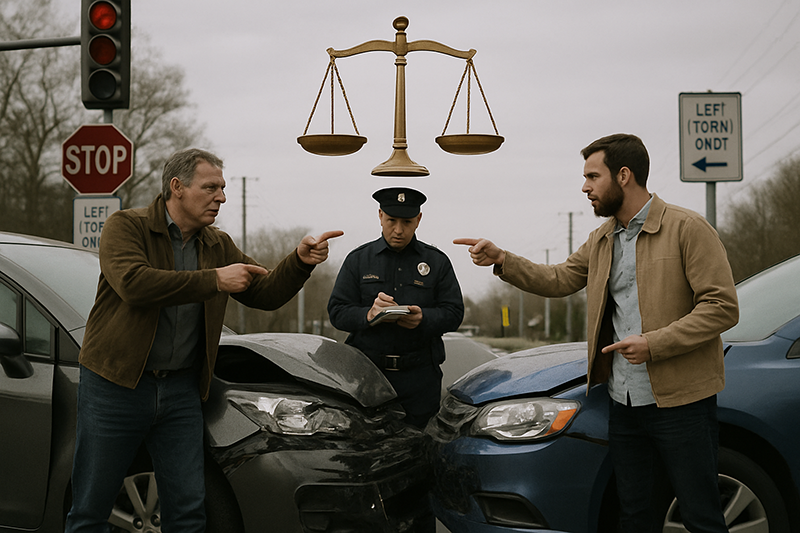
Liability (who is responsible for damages resulting from an accident), in the context of an automobile accident, depends on which person caused the car accident. Alaska also contemplates liability where both parties are at fault.
What can I do if I was also negligent?
This is a question that comes up quite often. It is very common for two people
to cause an accident, not just one. In that context, different states handle liability claims in different ways. As an example, I practiced in North Carolina for years. In North Carolina the rule of the land is contributory negligence. Under contributory negligence if you want to bring a claim against another driver, you cannot have been negligent in any causative way. In other words, if you contributed to the accident at all-even1%-you can recover nothing. Alaska’s rule is much more generous and understanding of the fact that someone who is injured through the carelessness of another should not have their claim barred by the fact that they had done some minor negligent act. Alaska’s rule is
comparative negligence. In a comparative negligence system, you can recover for your own damages but only to the extent that those damages conform to the fault of the other party. If that definition is a little bit of a difficult to get your head around, here is an example:
Example: If you have an accident and you have $10,000 in damages, and the finder of fact or the jury decides that you were 25% at fault, you would be awarded $7,500 or 75% of your loss since the defendant, according to the finding of the jury, contributed 75% to the accident in this example.
Alaska is also a pure comparative fault state. This can be important in situations
where someone is catastrophically injured but primarily at fault for the accident. In most comparative states the rule is modified comparative negligence. Under that structure an injured person cannot collect unless the other driver was more than 50% at fault. If someone is badly injured and a jury finds him or her to be 60% at fault for the accident, then they can recover nothing in a modified comparative state. Here in Alaska, that same person could recover 40% of their damages. Oftentimes that is more than enough to cover their medical bills in a catastrophic loss case.
Review
In other words, when asking the question, “do I have a claim?”, you must consider not only the other person’s fault, but your own fault. Furthermore, you should not assume that you have no claim simply because you contributed to the accident.
Of course, not everybody injured in a car accident was a driver. Often, passengers are injured. In nearly every case the passenger is going to have a claim against one or both drivers. Passengers should bring claims against one or both drivers if they are injured. The insurance companies will often arbitrate to decide how much fault each company should bear if there is a dispute about liability. It is almost never the case that the passenger’s recovery is reduced by any
amount for comparative negligence. In other words, a passenger should always be able to recover 100% of his/her damages, even if the car he or she was travelling in was at fault. He/she may just have to recover from both insurance companies.
One more thought about passengers. Many passengers- especially spouses of at-fault drivers- will refuse to bring a claim against the person that was driving their vehicle. “That’s my husband” or “that’s my best friend” or “that’s my wife’s parents”- we hear it all the time. “I don’t want to bring a claim against them. It will raise their insurance rates.” We’re going to talk about insurance rates later, but when deciding about whether to bring a
claim against someone, it’s important to mention right here and now that the person driving the car in a collision that is severe enough to injure one of his passengers has already taken all of the insurance hit that they’re going to take. That person’s premiums will increase in an accident involving bodily injury or an accident involving more than $1,000 in property damage. Regardless of the severity of the injury and regardless of how high the property damage is, they still get the same increase. So, to minimize treatment, suffer needlessly, and forgo a legal right for compensation because you don’t want to affect someone’s insurance rates is the result of a poor and uninformed decision. You should always check with an attorney about your options.