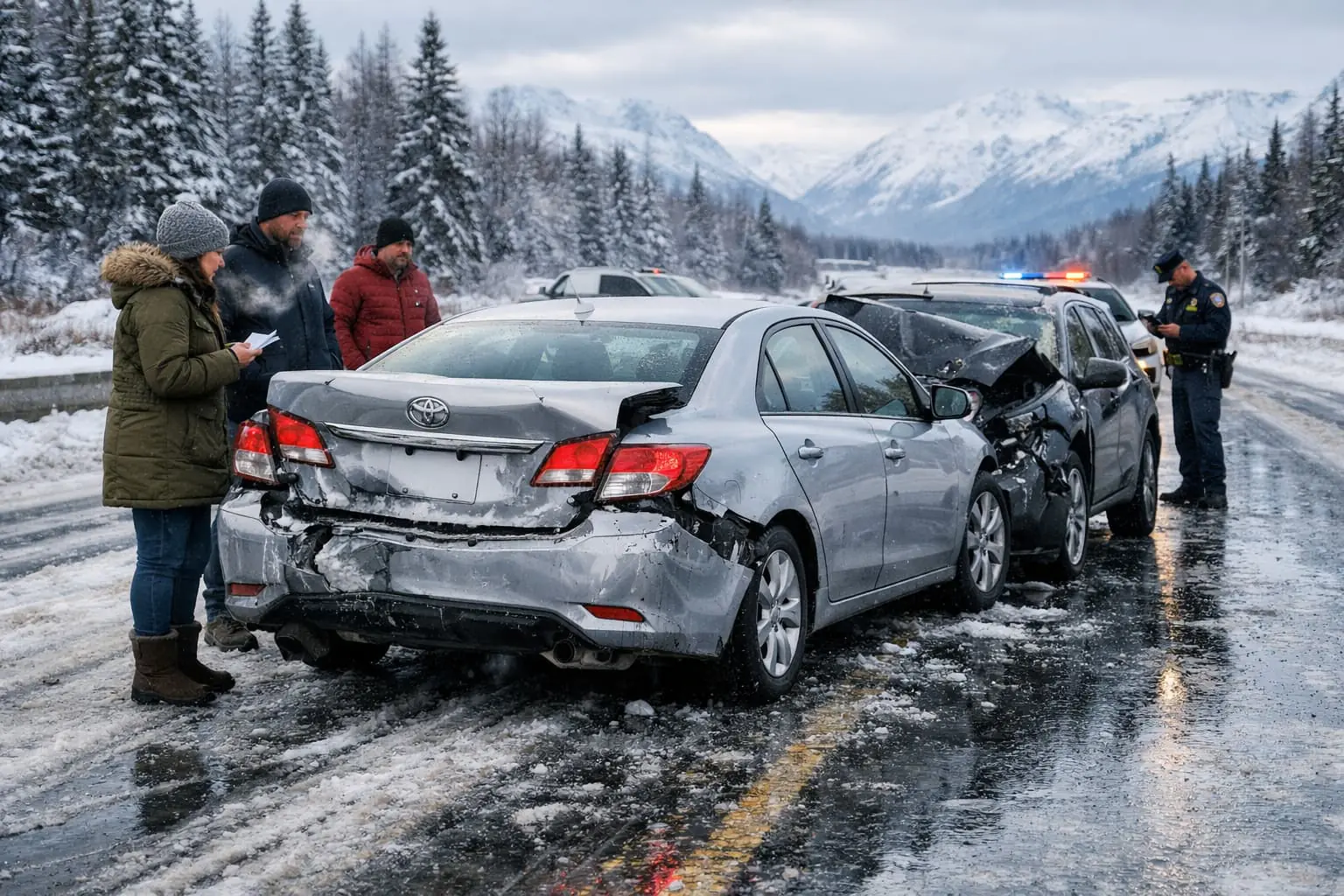
When someone rear-ends you and you hit the car in front of you, the question of who is liable rarely has a simple answer. These chain-reaction crashes involve multiple vehicles, competing insurance claims, and fault that may not fall on just one driver.
Many middle drivers assume they are automatically at fault because their vehicle struck another car. However, that assumption may be wrong. Alaska law looks at the specific facts of each collision, not just the order of impact. How fault is determined in these accidents depends on factors like speed, road conditions, and whether each driver maintained a safe following distance.
Chain-reaction rear-end crashes create a complex fault picture because multiple collisions occur in rapid succession. Sorting out liability requires a close look at what each driver did, or failed to do, in the moments before impact.
The rear driver often bears the heaviest share of responsibility. Alaska law expects every driver to maintain a safe following distance and to travel at a speed that allows them to stop safely. When a rear driver strikes a vehicle with enough force to push it into the car ahead, that single act of negligence may have caused both collisions.
Insurance adjusters and courts typically start their analysis with the rear driver. If that driver was distracted, speeding, or tailgating, their liability for the entire chain of events increases significantly.
Being rear-ended does not always eliminate the middle driver’s responsibility. If the middle vehicle was already too close to the car in front, the rear-end impact may not have been the only reason for the forward collision. Adjusters look at whether the middle driver left an adequate gap between vehicles.
Alaska’s icy roads and long winters make following distance especially important. A middle driver who was tailgating on the Seward Highway during winter conditions might share a portion of the fault, even though the rear driver initiated the chain reaction.
Front drivers in chain-reaction crashes rarely face liability questions. In most scenarios, the front vehicle was simply struck from behind with no opportunity to react. However, if the front driver stopped suddenly without reason, or if their brake lights were not functioning, some degree of fault might shift forward.
Alaska’s approach to shared fault plays a central role in multi-car accident claims. Rather than assigning blame to a single driver, the state allows fault to be divided among all parties involved.
Under Alaska’s pure comparative negligence statute, each driver’s compensation is reduced by their percentage of fault. If you are found 20% at fault and your total damages amount to $50,000, your recovery drops to $40,000. Unlike some states that bar recovery at 50% or 51% fault, Alaska allows injured drivers to pursue compensation at any fault level.
This system means that even if you share some blame as the middle driver, you may still recover a significant portion of your damages from the other at-fault parties.
Insurance adjusters assign fault percentages during their investigation. These percentages directly affect how much each insurer pays. A rear driver’s insurer might argue the middle driver was partly responsible to reduce their own payout.
Several factors influence how fault is divided in a multi-car accident:
These factors together help paint a picture of what happened. No single element determines fault on its own, which is why thorough documentation strengthens your position.
Many drivers confuse the police report with the final word on liability. In reality, insurance companies conduct their own investigations and may reach different conclusions than the responding officer.
A police report documents what the officer observed at the scene. It may include a preliminary fault assessment, but insurers are not bound by that opinion. Adjusters review the report alongside photos, witness statements, vehicle damage patterns, and sometimes accident reconstruction analysis.
If you were the middle driver, the police report might note that your vehicle hit the car ahead. That notation alone does not mean the insurer will assign you fault. The adjuster’s job is to determine causation, specifically whether you hit the car in front because you were pushed or because you were already too close.
Insurance adjusters evaluate liability for rear-end chain-reaction accidents by examining physical evidence and driver behavior. Damage location and severity often tell a revealing story. Key evidence that adjusters review includes:
The physical evidence often carries more weight than any single driver’s account. That is why preserving evidence from the scene, even through phone photos, matters so much.
This question sits at the heart of most middle-driver anxiety after a chain-reaction crash. The short answer is that being pushed into another vehicle by a rear-end impact does not automatically make you liable for the forward collision.
If the rear driver’s force alone caused your vehicle to strike the car ahead, liability may rest entirely with the rear driver. This argument holds strongest when the middle driver maintained a proper following distance and had no opportunity to prevent the forward collision.
Think of it this way: if your vehicle was at a complete stop when the rear driver hit you, and the force of that impact pushed you forward, the chain of causation points clearly to the rear driver.
Shared fault enters the picture when the middle driver’s own behavior contributed to the second collision. Situations that may lead to shared liability include:
Even in these situations, the rear driver typically retains the larger share of fault. Shared liability does not mean equal liability, and the specific percentages depend on the facts.
After the crash, the legal and insurance process unfolds in stages. Each driver’s insurer investigates independently, and the claims process may take time to resolve, especially when multiple vehicles and insurers are involved.
In a three-car rear-end crash, you may need to interact with more than one insurance company. As the middle driver, you might file a claim against the rear driver’s insurer while also responding to a claim from the front driver’s insurer.
Alaska’s mandatory insurance law requires liability coverage for most registered vehicles driven on public roads, and the DMV lists minimum limits of $50,000/$100,000 for bodily injury and $25,000 for property damage. Each insurer investigates its own policyholder’s liability and evaluates the claims filed against that policy.
The steps you take after a chain-reaction crash affect how your claim unfolds. Thorough documentation helps you fight for fair compensation and prevents adjusters from unfairly shifting blame.
Helpful actions to protect your claim include:
These records create a factual foundation that supports your account of the accident. Without them, liability disputes often come down to one driver’s word against another’s.
Alaska’s driving conditions create unique challenges that affect how liability is assessed. Winter weather, moose on roadways, and long stretches of highway between communities all influence stopping distances and driver behavior.
The Alaska Department of Transportation advises drivers to reduce speed and drive based on road and weather conditions. On snow or ice, drivers often need much more stopping distance than on dry pavement. These realities matter in liability disputes because adjusters and courts consider whether each driver adapted to conditions when they assign fault percentages.
A chain-reaction crash near Wasilla during a January whiteout raises different questions than a summer fender-bender on the Glenn Highway. The season, road surface, and visibility all factor into the analysis.
Multi-car accident claims involve competing narratives from each driver and each insurer. An Anchorage accident attorney may help clarify responsibility by gathering evidence, consulting with accident reconstruction professionals, and negotiating with multiple insurance companies on your behalf.
At Crowson Law Group, our attorneys have experience with complex Alaska accident cases where liability is disputed. A legal perspective may reveal details that adjusters overlook or undervalue.
Alaska does not have a formal statutory presumption, but courts and insurers generally view the rear driver as the party most likely at fault. The reasoning is that every driver has a duty to maintain a safe following distance. Rear-end crashes often start with a strong assumption that the rear driver followed too closely or failed to stop safely, but liability still depends on the evidence in the specific crash.
Alaska law requires liability insurance, but not every driver complies. If the rear driver lacked coverage, your own uninsured motorist (UM) policy may cover your damages. A UM claim is made under your own policy.
Alaska sets a two-year deadline for most personal injury claims, as established under Alaska Statute 09.10.070. This legal countdown timer starts from the date of the accident. Missing this deadline typically bars you from pursuing compensation through the courts.
Conflicting statements are common in multi-vehicle accidents. Physical evidence, such as damage patterns, skid marks, and data from vehicle event recorders, often helps resolve disputes. An independent accident reconstruction analysis may also clarify the sequence of impacts when driver accounts disagree.
If the investigation determines you were not at fault, filing a claim against the at-fault driver’s insurer generally does not raise your premiums. However, if your own insurer assigns you partial fault, rate increases may follow. Reviewing the fault determination with an attorney before accepting it may help protect your interests.
A chain-reaction crash on an icy Anchorage road or a busy Wasilla intersection leaves many people unsure about where they stand. The fear of being blamed for a collision you did not cause adds stress to an already difficult situation. At Crowson Law Group, our team talks through the details of Alaska multi-car accidents every day, and a free consultation may reveal options you did not know you had. Reach out through our contact page or call us anytime, day or night. There is no upfront cost to speak with our attorneys, and the conversation is always free.