To establish causation and quantify damages in Alaska neck-injury claims, you must present complete medical records, imaging studies, accident reports, expert analyses, witness testimony, and exhibits.
Your neck injury attorney should obtain all medical records from each treating healthcare provider because their detailed charts and summary notes with laboratory results demonstrate the progression and intensity of your injury. Requesting hospital bills and therapy notes helps prove the complete costs of care while showing the continuous treatment you received.
Your claim needs physician notes detailing your symptoms and treatment progress because these objective medical reports provide essential factual evidence. You must keep specialist reports alongside emergency room summaries because they reveal your medical diagnosis, path, and treatment process.
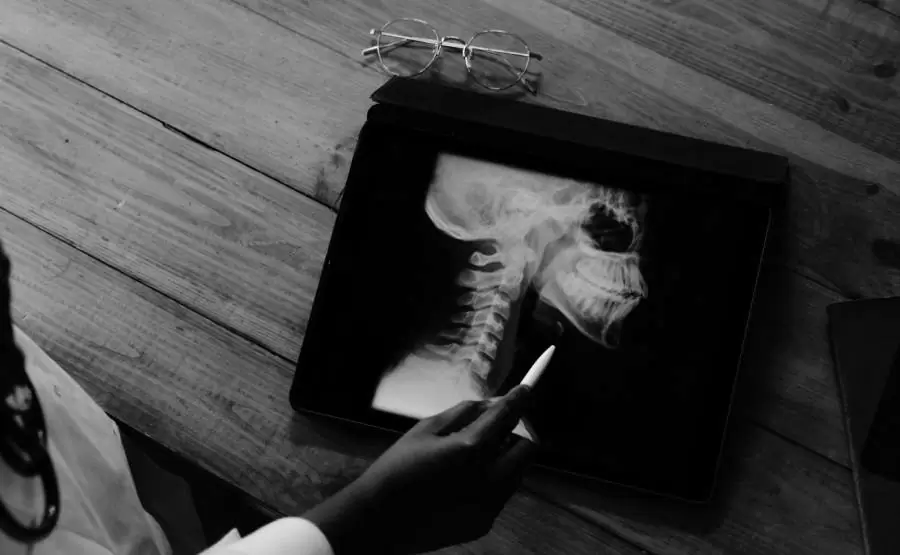
X-rays showing cervical spine fractures and alignment problems should be included because they visually demonstrate bone injuries to jurors. CT and MRI scans should be included to detect soft-tissue injuries, which X-rays cannot identify, such as herniated discs or torn ligaments.
You must contact the treating physician who treats you or an independent medical specialist to establish a direct connection between your neck injury and the accident mechanics. Your expert should demonstrate how chronic pain and restricted range of motion in the future will affect your care needs.
Obtaining police and incident reports is essential because these official documents document the crucial elements of who, what, and where regarding the crash. Visualization of road conditions and vehicle positions requires the collection of all scene photographs and surveillance video footage. After the impact, you should obtain statements from laypersons and expert witnesses to validate your memory and document any signs of distress at that moment.
Present evidence of your lost wages through pay stubs, tax returns, and employer letters to establish your missed income. Maintaining a diary that records your daily pain experiences and emotional distress through your own words will help your case.
To determine the offsets under Alaska’s collateral-source rule, you should maintain records of all disability and workers’ compensation benefits you received.
A professional accident-reconstruction expert should assess vehicle dynamics, including speed and angle of impact, to establish clear evidence of cause. A biomechanical or life-care planner should evaluate neck force vectors and calculate future care expenses.
Complex anatomy should become crystal clear to a jury through your use of 3D spine models, animated injury simulations, or colourized imaging.
The deadline to file your lawsuit is six years from the date of your last injury, according to AS 09.10.052, and noncompliance will result in legal forfeiture of your case. The pure comparative-fault law of Alaska (AS 09.17.060) will diminish your compensation according to your assigned percentage of fault, yet it will not eliminate your right to seek recovery.
Your recoverable damages under AS 09.17.070 must exceed all collateral-source benefits you received. The maximum non-economic damages under AS 09.17.010 are $500,000 per incident. When assessing the professional standard of healthcare providers, you must apply the definition of professional negligence found in AS 09.55.560.
Your neck injury claim will obtain fair compensation using medical and accident records and expert advice while following Alaska’s statutes.
Featured Image Source: https://www.pexels.com/photo/person-holding-cigarette-stick-and-photo-frame-5452245/